
home > Pablication


2018 2017 2016 2015 2014 2013 2012 2011
2010 2009 2008 1998–2007
“Bromonium-Catalyzed 1,2-Diamination of Various Conjugated Alkenes"
Takeshi Sugiyama, Ryo Nakajima, Yuuka Kakizaki, Yuki Yamada, and Satoshi Minakata*
Chem. Sci. 2026, Advance Articles. DOI:10.1039/d6sc06084f
*Open-access article"!
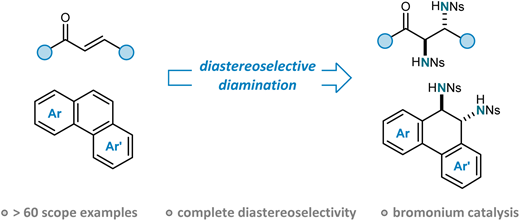
Abstract: Alkene functionalization via cyclic halonium intermediates is highly effective for stereocontrol, and a catalytic approach further expands this strategy, offering access to more advanced functionalization. Although various studies have utilized halonium species, expanding their scope to electron-deficient or π-conjugated alkenes has remained challenging. In this report, using a bromonium catalytic system, we achieved the stereoselective intermolecular 1,2-diamination of various α,β-unsaturated carbonyl compounds and π-extended alkenes. The direct use of hazardous Br2 was avoided by generating the active species, dibromamine-Ns (Br2NNs), in situ from stable dichloramine-Ns (Cl2NNs) and NaBr. The reaction proceeded with complete anti-selectivity, and mechanistic studies revealed a stereoselective pathway involving catalytic aziridination followed by ring opening. The resulting nosyl-protected diamines can be flexibly deprotected and derivatized, providing rapid access to useful scaffolds such as unnatural amino acids and nitrogen-containing functional molecules.
“Dual-State Photophysical Modulation via Bifurcated Hydrogen Bonding in a U-Shaped Dipyridophenazine-Cored Donor-π-Acceptor-π-Donor Fluorophore"
Kimiya Takei, Shunsuke Kobashi, Divya, Norimitsu Tohnai, Satoshi Minakata, Yoichi Kobayashi*, Piotr de Silva*, and Youhei Takeda*
Chem. Eur. J. 2026, 32, e03421. DOI:10.1002/chem.202503421s
*Open-access article"!
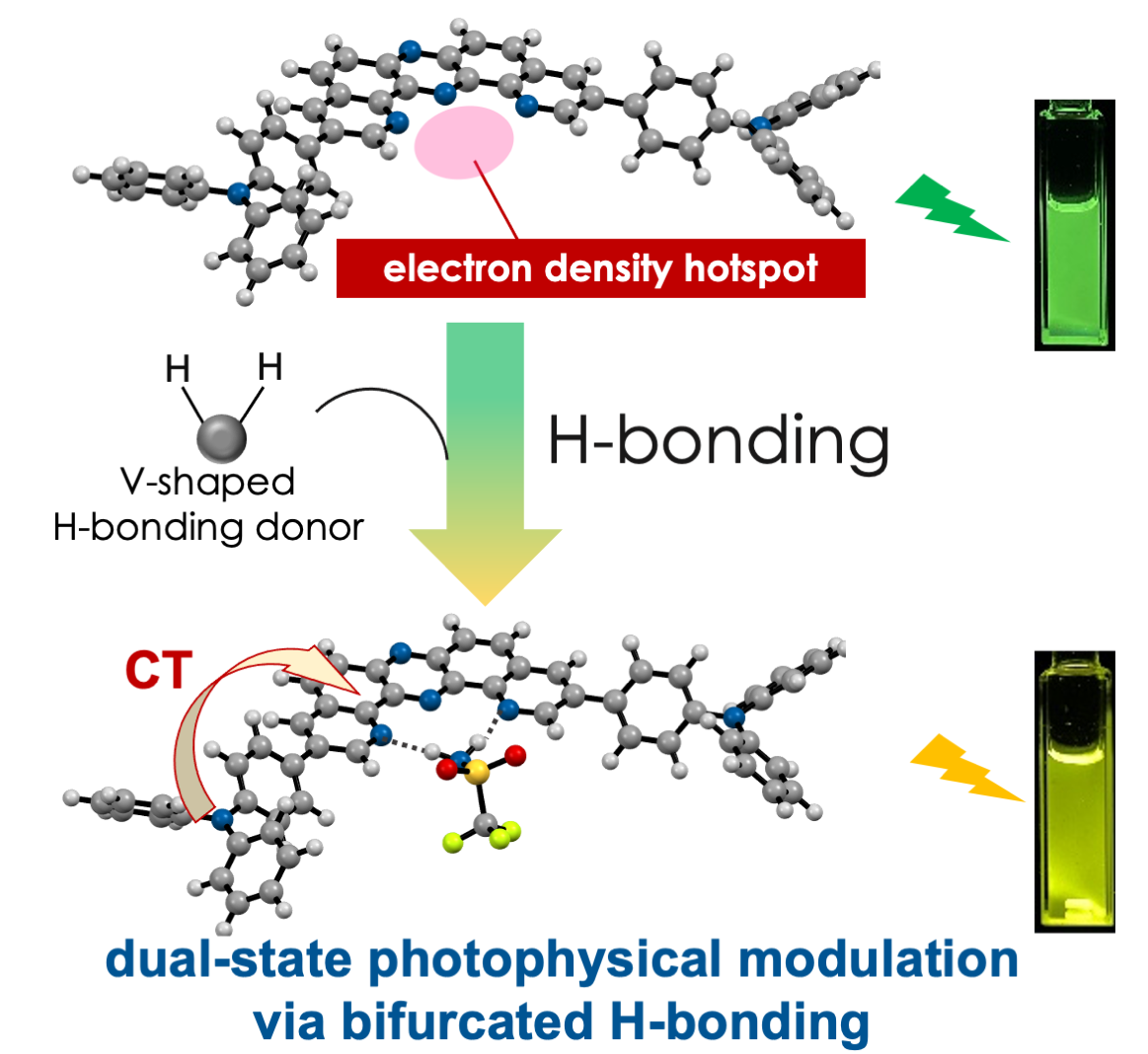
Abstract: Modulating photophysical properties via hydrogen bonding offers a powerful strategy for designing supramolecular functional materials and responsive optical systems. Here, we present a U-shaped dipyridophenazine (DPyPHZ)-cored donor–π–acceptor–π–donor (D–π–A–π–D) scaffold that serves as a hydrogen-bond receptor capable of forming bifurcated hydrogen bonds, enabling simultaneous modulation of both ground and excited states. We developed an efficient synthetic route to this π-conjugated system, and demonstrated that its absorption and emission spectra undergo pronounced red-shifts upon 1:1 complexation with neutral hydrogen-bond donors such as sulfonamides and even water. Spectroscopic analyses reveal that the hydrogen-bonding interaction stabilizes the charge-transfer excited state, leading to enhanced photoluminescence quantum yield (PLQY) and color modulation. Notably, these optical responses persist in the solid state when embedded in a polymer matrix, enabling emission color switching without fluorophore aggregation. Single-crystal X-ray analysis confirmed the formation of a well-defined bifurcated hydrogen-bonding complex in the solid state. Comparative studies with structural analogues highlight the importance of the electron-density hotspot in DPyPHZ for selective and directional hydrogen bonding. This work introduces a supramolecular design strategy for precise dual-state photophysical control, providing a platform for environmentally responsive luminescent materials with potential in sensing, imaging, and optoelectronic applications.